REVIEW · FLORENCE
Duomo Museum & Baptistry: Cathedral Complex & Bell Tower
Book on Viator →Operated by Florence and Global Small group tours · Bookable on Viator
One building complex can teach you an entire city. This tour ties together Florence’s cathedral art and dome craftsmanship with guided time where it counts. You’ll also get the kind of exterior time you can actually enjoy, not just race through.
I especially love how the day balances big-ticket sights with high-impact details. The Opera del Duomo Museum makes the story of the Duomo feel concrete, from the reconstructed façade to Michelangelo and Donatello sculptures. And the dome climb payoff is real: tight Florence views, right where your photos look best.
One consideration: the main interior of Santa Maria del Fiore isn’t part of the guided plan here. It’s free, but it can mean extra lines, and your group route focuses on the museum, Baptistery, and the dome area instead.
In This Review
- Key things to know before you go
- Florence’s Duomo complex: why this tour is a smart hit
- Stop 1: Opera del Duomo Museum (and the Sala del Paradiso wow-factor)
- Sala del Paradiso: the reconstructed façade
- Ghiberti’s Gates of Paradise, protected and close
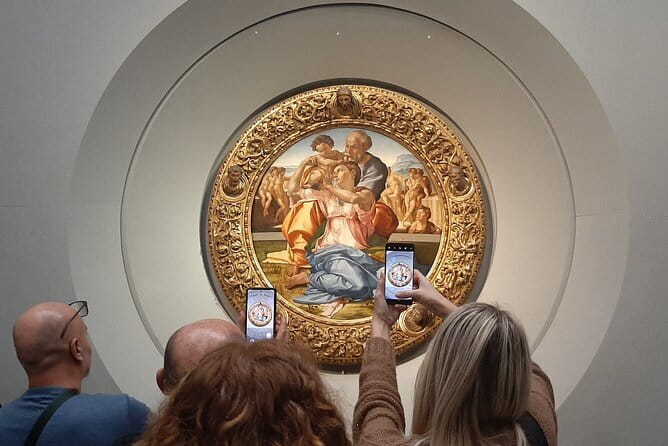
- Michelangelo and Donatello sculptures that hit harder than expected
- Brunelleschi dome: tools and models before you climb
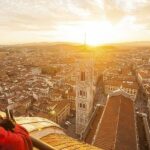
- Brunelleschi Terrace: one of Florence’s best photo moments
- Stop 2: Piazza del Duomo exterior time (yes, you’ll still get gelato vibes)
- Stop 3: Baptistero di San Giovanni interior highlights (gold mosaics and bronze doors)
- The Last Judgment ceiling: why the light matters
- The Gates of Paradise: where Michelangelo’s comment fits in
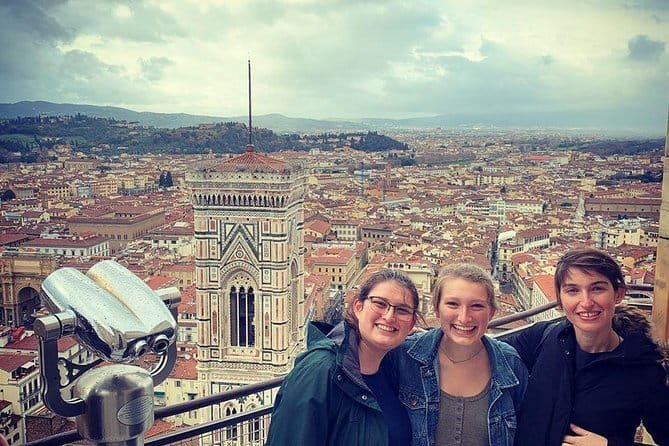
- The dome climb experience: views you earn, with a realistic approach
- How the guided plan and self-guided time fit together
- Price and value: what $76.88 buys you here
- Meeting point reality check: arrive early and watch the flag
- Who this tour is best for (and who might want another option)
- Should you book the Duomo Museum & Baptistry tour with dome focus?
- FAQ
- How long is the tour?
- What’s included in the guided part?
- Is the Cathedral interior included?
- Does the tour include the Crypt of Santa Reparata?
- Is the Giotto Bell Tower climb included?
- Do I need to print tickets?
- Are headsets provided?
- What if the weather is bad?
- What’s the group size?
- What is the cancellation window?
Key things to know before you go
- Sala del Paradiso at the Opera del Duomo Museum: a life-size 14th-century façade reconstruction with 40 statues.
- Ghiberti’s Gates of Paradise in protected form: originals are shown here rather than exposed to the weather.
- Brunelleschi dome context before you climb: tools and models help you understand what you’re walking through.
- Baptistery mosaics that glow: 1,000+ square meters of gold-leaf ceiling art.
- Headsets included: you won’t have to play guessing games in crowds.
- Optional Giotto Bell Tower climb: self-guided ticket included if you choose that add-on.
Florence’s Duomo complex: why this tour is a smart hit
Florence can feel like a giant museum all at once. The Duomo complex is the core of that feeling. It’s where the Middle Ages meet the Renaissance, where you can study sculpture up close, and where you can earn those iconic skyline views by climbing.
What makes this tour work well for most people is the pacing. You get a guided visit long enough to make the art make sense, then you get enough time outdoors to actually take it in. And because the group is kept small (max 19, with small-group leadership aimed around about 12), the guide can keep the story flowing instead of bouncing you along like luggage.
Also, you’re not stuck trying to hear a mumble under crowded arches. High-quality headsets are included, so you can keep your attention on what the guide is pointing out.
You can also read our reviews of more tours and experiences in Florence.
Stop 1: Opera del Duomo Museum (and the Sala del Paradiso wow-factor)
This is the best place to start if you want to understand the Duomo complex, not just see it. The Opera del Duomo Museum sits right behind the Cathedral, and it’s basically Florence’s art workshop story—what got made, why it mattered, and what survived.
Sala del Paradiso: the reconstructed façade
The star is Sala del Paradiso. It’s a huge hall with a life-size reconstruction of the Cathedral’s original 14th-century façade. You’ll see 40 statues placed in context, including work by masters like Donatello. If you’ve ever wondered what the Duomo looked like before the current look, this room does that heavy lifting fast.
The experience is visual, but the guide’s job is to make it meaningful. You’re not just looking at famous names—you’re learning how these sculptures were meant to act like a public lesson for a religious city.
Ghiberti’s Gates of Paradise, protected and close
Right across from the façade reconstruction, you can see one of the big attractions: the original Gates of Paradise by Lorenzo Ghiberti. They were moved here to protect them from the elements. That matters because it helps you appreciate the work as an object, not just a distant panel behind ropes.
If you’re a detail person, this is where you’ll slow down. The craftsmanship is the point, and the museum setting makes it easier to focus.
Michelangelo and Donatello sculptures that hit harder than expected
The museum also houses major works tied directly to Florentine religious art, including:
- Michelangelo’s Pietà Bandini, created for his own tomb project
- Donatello’s Penitent Magdalene, known for its striking realism in wood
Even if sculpture isn’t usually your thing, this stop works because it gives you multiple entry points—style, materials, and the idea of devotion translated into art you can stand next to.


Brunelleschi dome: tools and models before you climb
Another smart part of the museum visit is the section about Brunelleschi’s Dome. You’ll see original 15th-century tools and wooden models. That’s not “just trivia.” It changes how you experience the dome climb: you start noticing architecture and engineering choices instead of only thinking about stairs.
Brunelleschi Terrace: one of Florence’s best photo moments
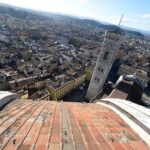
The museum visit ends at the Brunelleschi Terrace. This is where you get a close-up view that helps your camera do what it wants: sharp angles, strong curves, and scale you can’t fully appreciate from the square.
Stop 2: Piazza del Duomo exterior time (yes, you’ll still get gelato vibes)
You’ll step into Piazza del Duomo, the historic heart of the complex. This open space is important because it’s the transition point: it’s where Florence’s medieval identity meets Renaissance ambition.
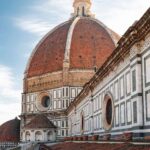
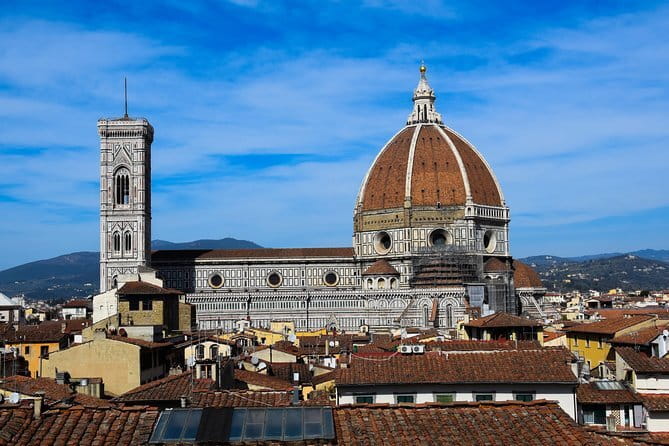
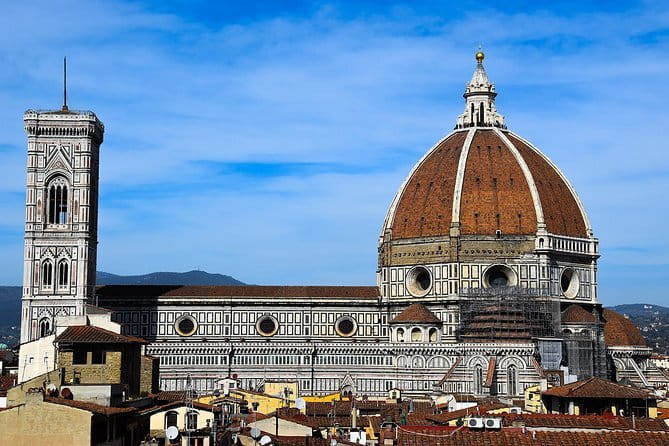
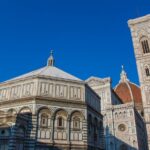
The Cathedral of Santa Maria del Fiore dominates the square, including Brunelleschi’s famous red-tiled dome. The exterior marble patterning—white, green, and pink—helps connect the buildings into one visual system, not separate monuments.
To the side, Giotto’s Bell Tower adds a vertical rhythm to the scene. And directly in front of the Cathedral sits the Baptistery of San Giovanni, an octagonal building that’s older than most surrounding structures and acts like the complex’s anchor.
This is the outdoor part that’s worth slowing down for. You won’t just be marching to the next ticket booth. You’ll be in position to look, orient yourself, and line up photos without rushing.
Stop 3: Baptistero di San Giovanni interior highlights (gold mosaics and bronze doors)
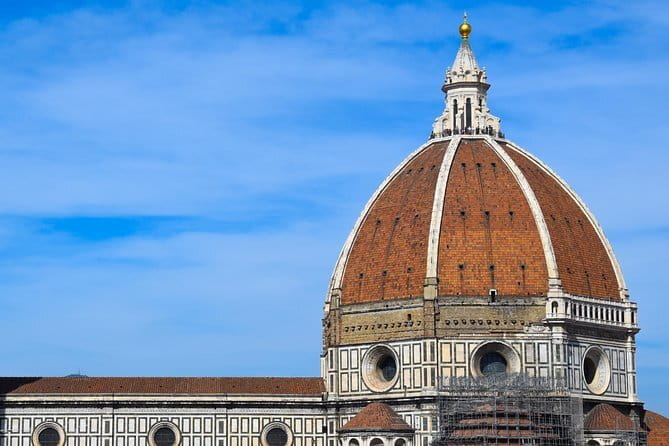
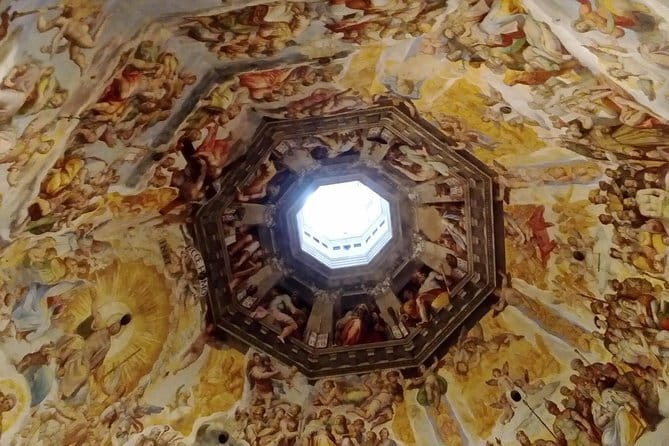
The Baptistery is one of those places where you feel the scale of devotion. It’s built as an octagon and wrapped in white and green marble. Inside, the main draw is the ceiling—over 1,000 square meters of 13th-century gold mosaics.
The Last Judgment ceiling: why the light matters
The mosaics depict scenes including the Last Judgment. The gold-leaf effect is designed to glow when light hits it. In practical terms, this means your time inside the Baptistery is best spent looking up and not just scanning for the next stop.
If you’re the type who likes to understand what you’re seeing, this is where the guide’s story helps a lot. Religious imagery can feel abstract, but having context makes it stick.
The Gates of Paradise: where Michelangelo’s comment fits in
You’ll also see the bronze doors, especially the eastern set known as the Gates of Paradise. These are linked to Lorenzo Ghiberti, and they’re so famous that Michelangelo is said to have compared them favorably—like they belonged to an entrance to heaven.
Historically, many Florentines were baptized here, including Dante Alighieri. That civic detail matters because you start thinking of this as more than a tourist stop. It’s part of how Florence understood life, faith, and identity.
The dome climb experience: views you earn, with a realistic approach
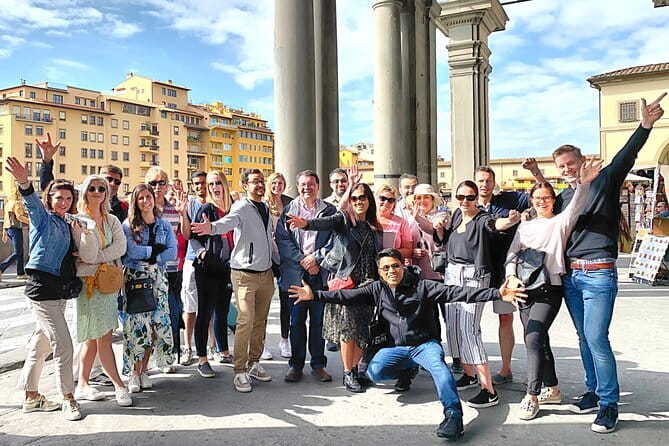
The dome climb is the headline for a reason. You’re going up into the engineering layer that makes the Duomo complex legendary. You also get close-up views that most people never see unless they climb.
From practical experience, what makes the dome climb worth it is pacing. Even on a windy or cool day, a good guide keeps moving and keeps people comfortable—without turning it into a speed drill. There are also spots to rest along the way, which helps if you’re not a gym climber but you still want the payoff.
A few tips you should actually take seriously:
- Wear tennis shoes or other grippy footwear. Stone steps can be slick.
- Dress for stairs, not style. Avoid wide-legged pants that can get annoying in tight spaces.
- If you climb when it’s cooler, you’ll usually enjoy it more.
And here’s a sweet bonus: the climb and the museum visit work together. You’re not just walking up because it’s famous. You’re walking up with context you already heard.
How the guided plan and self-guided time fit together
This is not a one-size-only guided tour. It’s a guided backbone with self-guided add-ons inside the same complex.
You’ll have:
- A 1.5-hour guided focus covering the Opera del Duomo Museum and the Baptistery
- Self-guided access to the Crypt of Santa Reparata
- A self-guided ticket for the Giotto Bell Tower climb if you selected that option
- Ticket validity for 72 hours for the self-guided locations in the complex
That 72-hour window is more useful than it sounds. The Duomo complex is famous for lines and crowd flow changes, and you might want to return later for better timing or just a calmer look.
Price and value: what $76.88 buys you here
At $76.88 per person, this tour sits in the “you’re paying for time and expertise” category. The math is simple: you’re getting guided art explanations plus entry to the major museum and Baptistery parts, with dome-climb value added by the route’s focus.
If you’re the sort of traveler who reads nothing and watches no guides, you could probably cobble together tickets on your own. But if you want the story connected to the art—why these pieces exist and what they replaced—this format saves you mental work and physical time.
Also, the small-group approach matters. When the group is kept limited, your guide can actually move the group as a group, not as a herding problem.
Where you should be cautious is the scope. You’re not being guided through the interior of the Cathedral itself. If you strongly want inside-the-church time during the same visit, plan for that extra step separately.
Meeting point reality check: arrive early and watch the flag
The Duomo complex is confusing even when you’re trying hard. Multiple entrances, multiple signs, and lots of people doing their own thing can turn your first 10 minutes into a mini scavenger hunt.
Here’s what I recommend so you avoid frustration:
- Arrive a bit early and give yourself buffer time for crowd flow.
- Look for the guide holding a flag. It may not be high and obvious in the middle of a busy crowd.
- If the meeting point details look like they refer to different spots, treat it as a signal to confirm what you’re seeing in front of you.
Once you find the group, the experience usually settles into a smooth rhythm.
Who this tour is best for (and who might want another option)
This tour fits best if you:
- Want the Duomo Museum context before you climb
- Love sculpture and Renaissance artwork more than generic photo stops
- Appreciate clear guidance with headsets in crowded spaces
- Plan to do the dome climb and want it explained, not just endured
You might look elsewhere if:
- You mainly want the interior of the Cathedral church itself during this same outing
- You strongly dislike stairs or tight indoor spaces (the tour calls for moderate physical fitness)
- You’re hoping for a long sit-down museum experience with lots of free wandering time
Should you book the Duomo Museum & Baptistry tour with dome focus?
Yes—if your priority is understanding what you’re seeing at the Opera del Duomo Museum and then earning great Duomo views from the climb. The strongest reason to book is the way the art and architecture connect: you start with the reconstructed façade and master sculptures, then you get the golden mosaics, and you climb with context in your head.
If you can handle stairs, wear good shoes, and show up early enough to find your meeting point, this is a high-value way to experience Florence’s most important complex without losing the plot.
FAQ
How long is the tour?
It runs about 2 hours 15 minutes (approx.).
What’s included in the guided part?
You get a guided visit of the Opera del Duomo Museum and the Baptistery for about 1.5 hours, plus entry fees and taxes for the included monuments.
Is the Cathedral interior included?
No. Entrance to the interior of the Cathedral is free, but it is not included in the guided plan and requires waiting in line.
Does the tour include the Crypt of Santa Reparata?
Yes, you get a self-guided entrance ticket to the Crypt of Santa Reparata.
Is the Giotto Bell Tower climb included?
A self-guided ticket for the Giotto Bell Tower climb is included only if you select that option.
Do I need to print tickets?
No. You’ll use a mobile ticket.
Are headsets provided?
Yes. High-quality headsets are included so you can hear the guide clearly.
What if the weather is bad?
The experience requires good weather. If it’s canceled due to poor weather, you’ll be offered a different date or a full refund.
What’s the group size?
The tour has a maximum of 19 travelers, with small-group size emphasized.
What is the cancellation window?
Free cancellation is available. You can cancel up to 24 hours in advance for a full refund. If you cancel less than 24 hours before the start time, the amount paid isn’t refunded.